
Toughness, Ductility and Post Crack Residual Strength Explained
Quite simply, post crack residual strength, toughness and ductility describe how fibre reinforced concrete behaves after cracking. Although these behaviours are closely related, they are not interchangeable as they do not measure the same parameters.
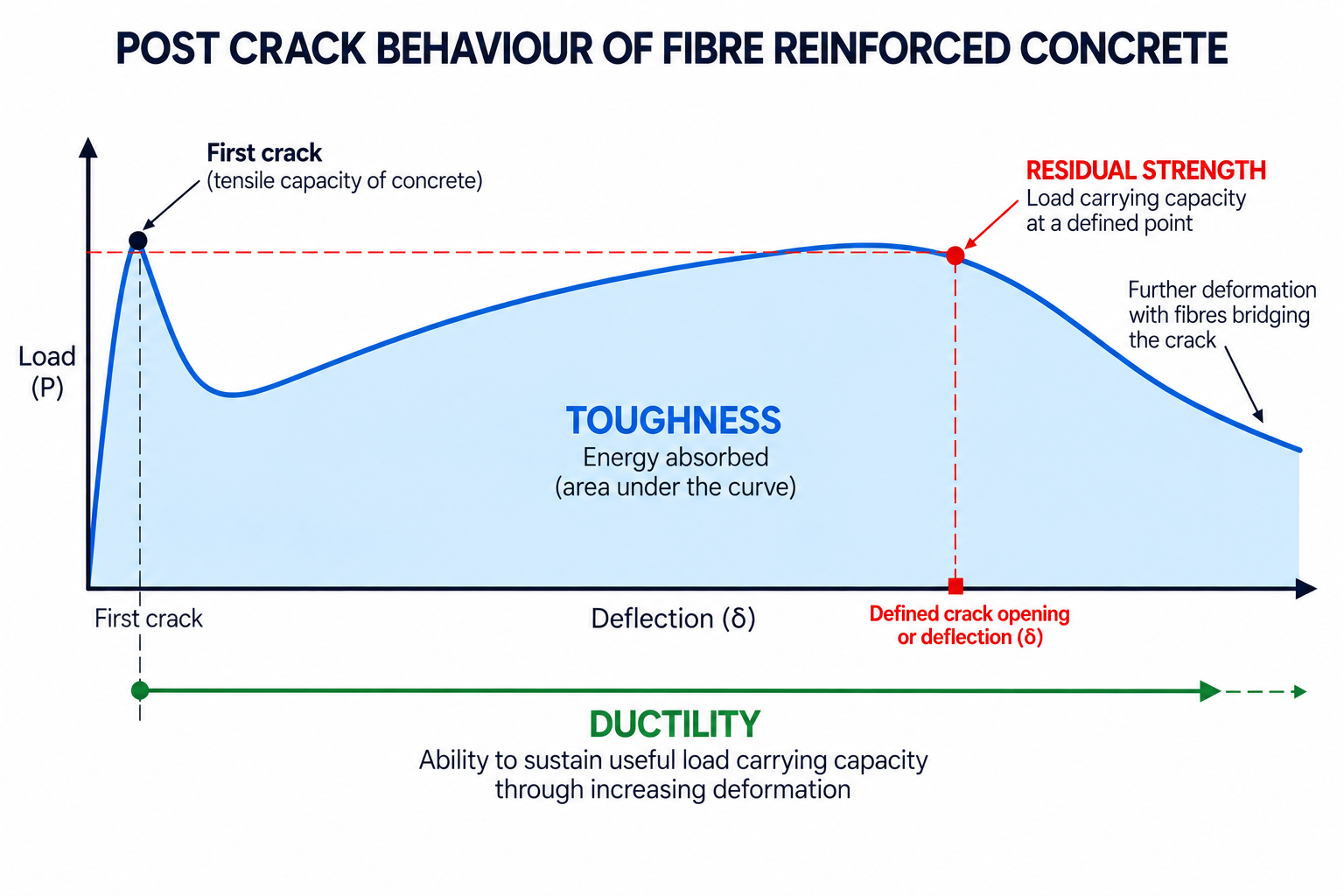
Concrete is inherently brittle in tension. Once cracking occurs, reinforcement provides the mechanism that allows tensile forces to continue being transferred across the crack. In conventionally reinforced concrete, this is provided by reinforcing bars or mesh, while in fibre reinforced concrete it is provided by fibres distributed throughout the concrete matrix. Residual strength, toughness and ductility each measure different aspects of this post crack behaviour. At their most basic, the difference between the three can be summarised as follows:
Post crack residual strength = how much strength remains at a defined point after cracking.
Toughness = how much energy the concrete can absorb after it cracks and deforms.
Ductility = how much the concrete can deform after cracking without failure.
Understanding the difference between these three concepts matters because the real value of structural fibre reinforcement is not in preventing concrete from cracking altogether, but in controlling what happens after a crack forms.
Why Post Crack Behaviour Matters
Concrete performs extremely well in compression but has a comparatively low tensile capacity. Once tensile stresses exceed the tensile capacity of the concrete matrix, a crack forms and plain concrete can lose its load carrying capacity very quickly.
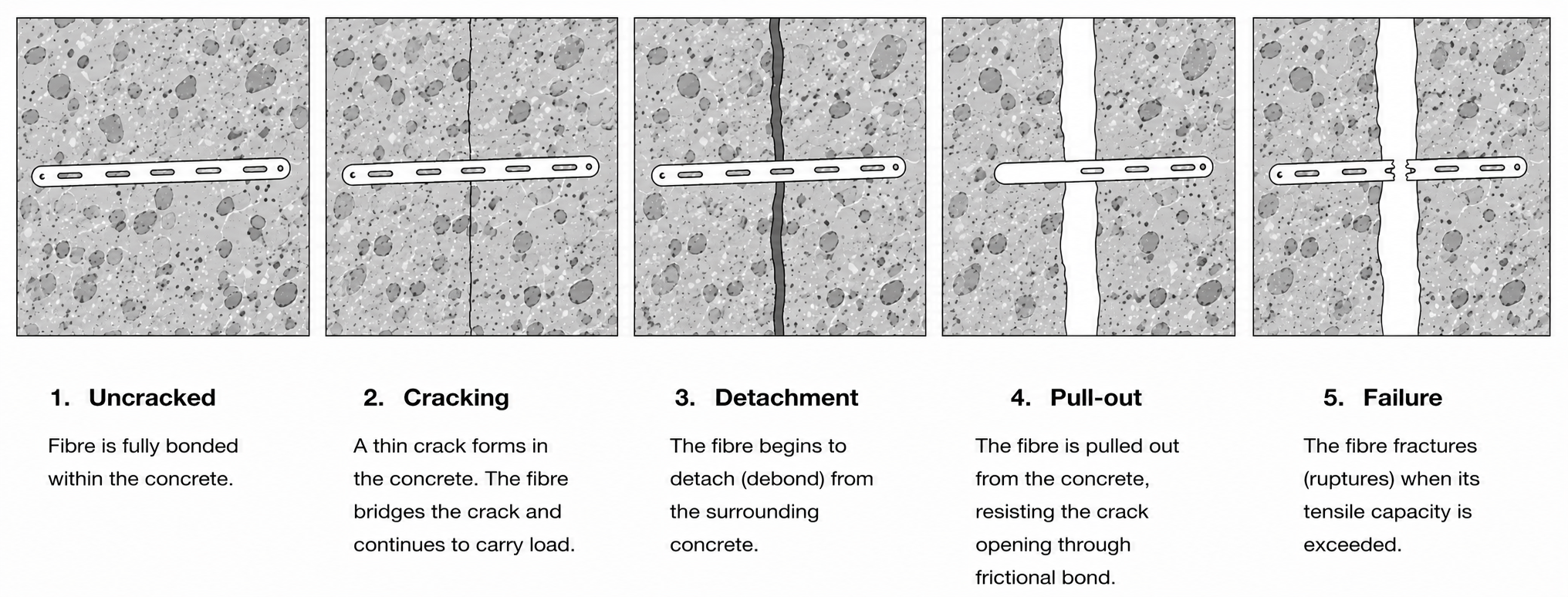
Fibre reinforcement changes this behaviour by bridging the crack as it develops. Instead of the crack immediately separating the concrete into two independent sections, fibres crossing the crack continue to transfer tensile forces from one side to the other. This allows the concrete to retain useful load carrying capacity after cracking and gives fibre reinforced concrete its characteristic post crack behaviour.
Residual flexural testing is therefore designed to measure the ability of fibres to bridge cracks and continue carrying load after the concrete matrix has cracked.
What is Post Crack Residual Strength?
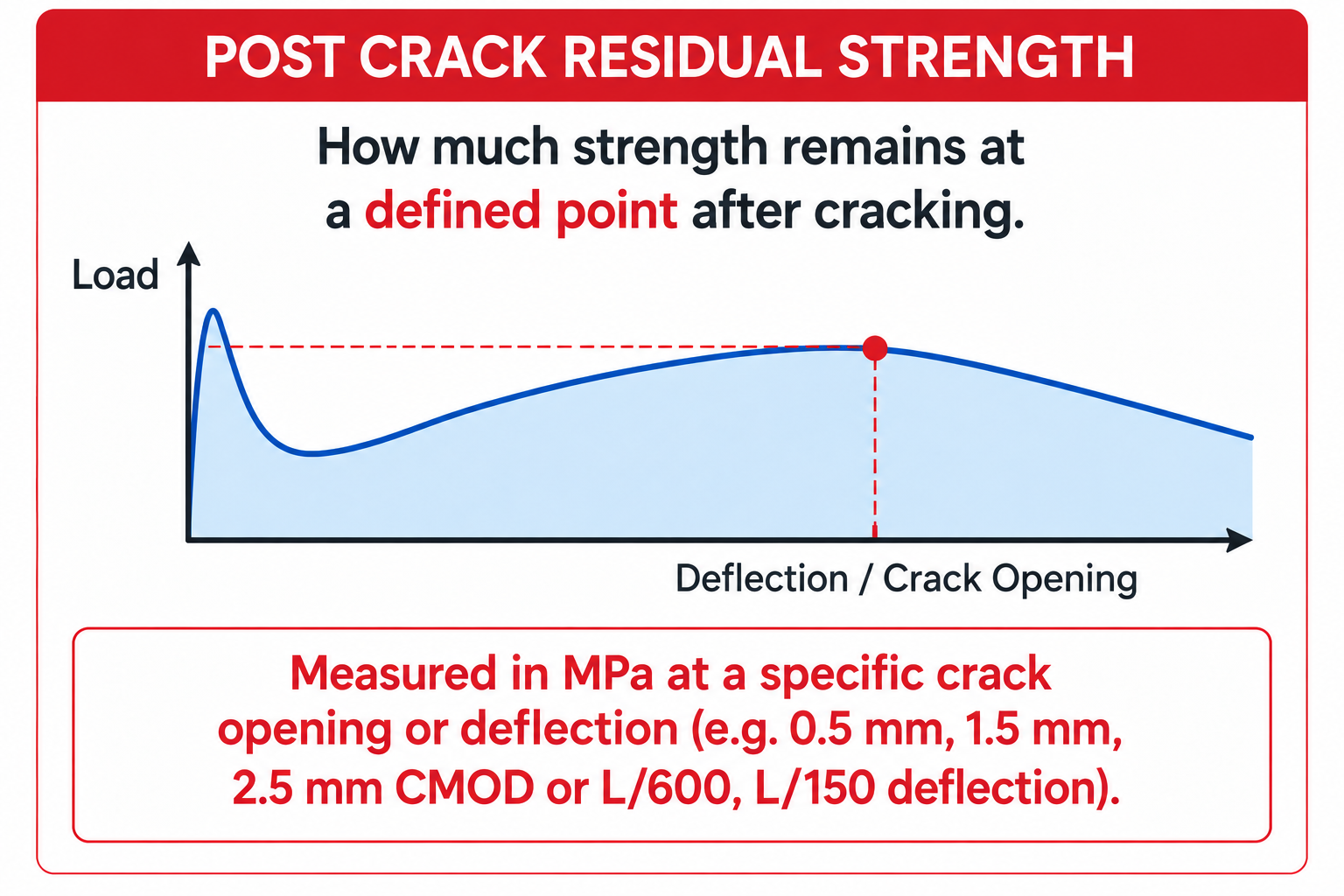
Post crack residual strength describes the load carrying capacity that remains in concrete at a defined crack opening or deformation after cracking. Depending on the test method and context, this may also be referred to as residual flexural strength or, more specifically, residual flexural tensile strength.
A simple way to think about residual strength is to imagine a concrete beam under increasing load. Before cracking, the concrete matrix provides the tensile resistance. Once its tensile capacity is exceeded and a crack forms, reinforcement intersecting the crack provides a mechanism for tensile forces to continue being transferred as the crack opens. In fibre reinforced concrete, this mechanism is provided by fibres bridging the crack.
The important point is that residual strength is not a single measure of the entire post crack response. It measures the remaining load carrying capacity at a defined point. By measuring residual strength at several crack openings or deflections, engineers can see how that capacity changes as cracking and deformation progress.
Post crack residual strength is typically determined through controlled flexural testing. EN 14651 measures residual flexural tensile strength at defined crack openings, including fR1 at a CMOD of 0.5 mm and fR3 at a CMOD of 2.5 mm, values commonly used in structural design to characterise serviceability and ultimate limit state performance. ASTM C1609 instead measures residual flexural performance at defined beam deflections, commonly including L/600 and L/150, where L is the test span. Although both tests characterise post crack performance, they use different specimen configurations and different measures of deformation.
What is Toughness?
Toughness describes how much energy the fibre reinforced concrete can absorb as it cracks and deforms.
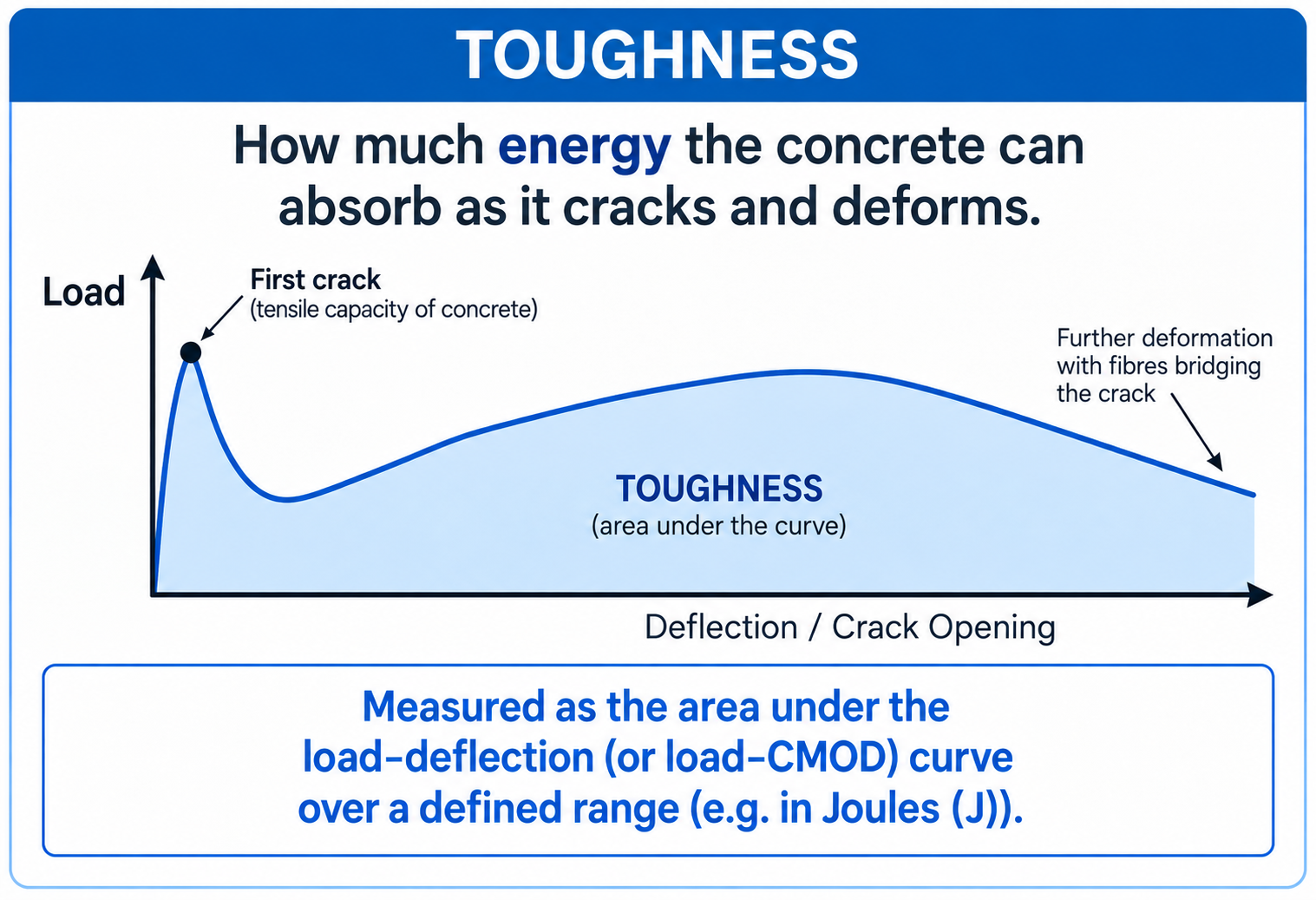
A fibre reinforced concrete specimen that continues to carry substantial load as it deflects will absorb more energy than one that loses load carrying capacity rapidly after cracking.
The easiest way to visualise the difference between residual strength and toughness is to think of the same load-deflection graph. Residual strength is the height of the curve at a particular point, while toughness is the total area underneath the curve within a defined deflection.
Toughness is typically measured using energy absorption tests, including the ASTM C1550 Round Panel and EN 14488-5 Square Panel. The energy absorbed is calculated from the area under the load-deflection curve and is normally expressed in Joules (J).
What is Ductility?
Ductility describes the ability of a material or structural element to deform after cracking while continuing to carry load, rather than failing suddenly in a brittle manner. In fibre reinforced concrete, it is best understood by examining how the material behaves throughout the post crack response.
A simple way to understand ductility is to compare two FRC specimens after they crack. One may initially retain a high level of residual strength but lose that capacity quickly as the crack opens. Another may carry less load immediately after cracking but maintain a significant proportion of that capacity through much greater crack openings or deflections. The second response may be considered more ductile because the useful load carrying capacity is maintained through greater deformation.
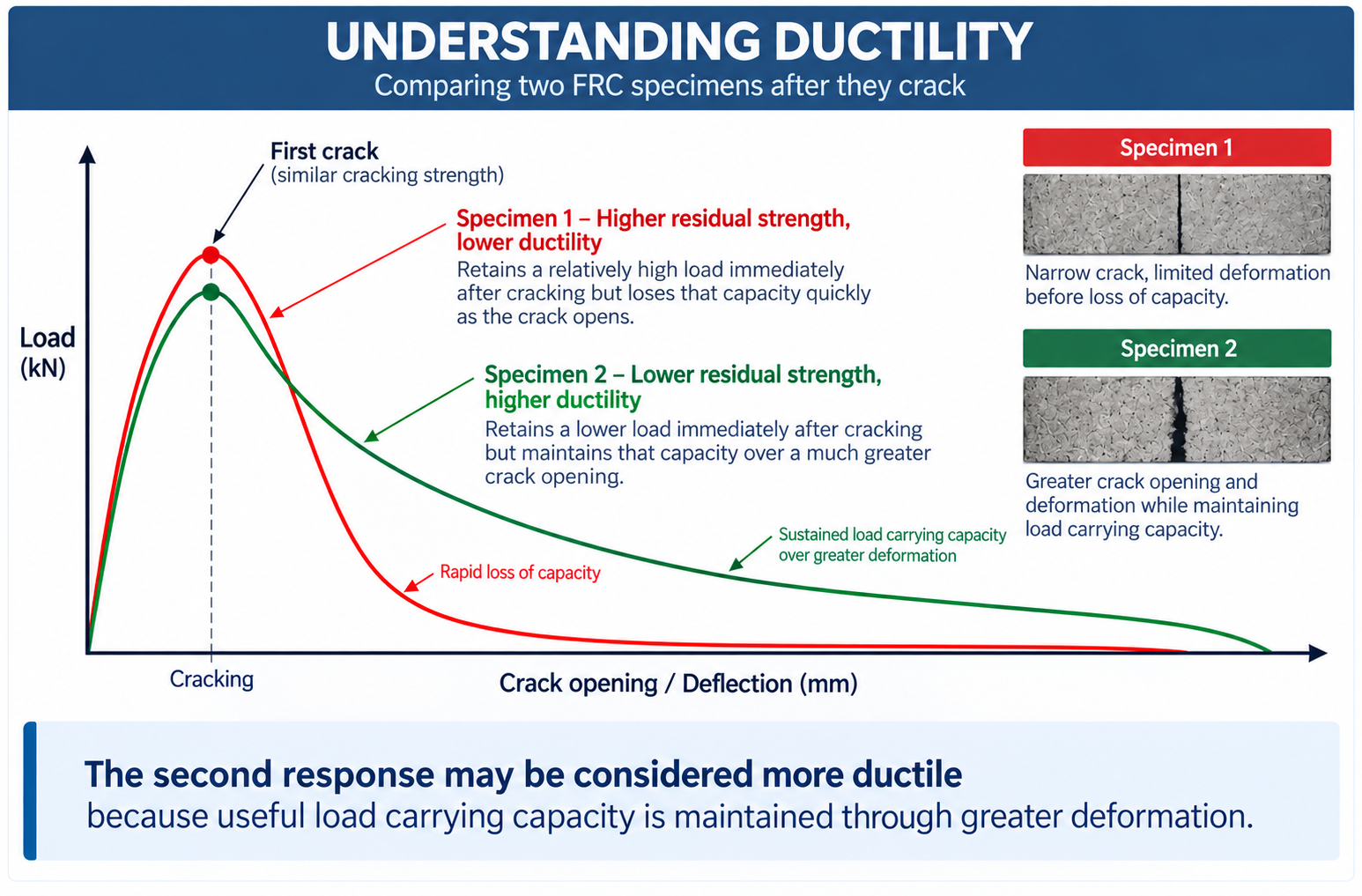
This is why high residual strength does not necessarily mean high ductility. Residual strength refers to the capacity at a defined point, whereas ductility describes how progressively the material can deform while continuing to carry load. Unlike residual strength or toughness, there is no single universal FRC test method that defines ductility. Instead, engineers can assess ductile behaviour by reviewing the complete load-deformation response produced by tests such as EN 14651, ASTM C1609 and ASTM C1550.
Ductility can be quantified where a particular design method defines specific deformation limits, ratios or ductility criteria. More generally, however, assessing the ductility of an FRC response requires engineering interpretation of the complete post crack curve and an understanding of the deformation demands of the intended application.
The important distinction is therefore that ductility is not simply how much strength remains, but how well that strength is maintained as deformation continues.
Fibre Reinforcement vs Traditional Mesh
Both traditional steel reinforcement and structural fibres provide a mechanism for transferring tensile forces after concrete has cracked, but they do so in different ways.
Steel mesh provides reinforcement at a defined depth within the concrete section. For the reinforcement to become effective, a crack must form and intersect the mesh, allowing tensile forces to be transferred through the steel. Its post crack performance is therefore strongly influenced by the location of the reinforcement, reinforcement ratio, bond and the position and development of the crack.
Fibre reinforcement is distributed throughout the concrete matrix. As cracks develop, fibres intersecting the crack path bridge the crack and continue transferring tensile forces across it, providing post crack resistance throughout the reinforced volume rather than at a single reinforcement plane.
This distributed reinforcement can provide effective residual strength, toughness and ductile post crack behaviour while also controlling the development and opening of cracks. The required performance can then be engineered through the fibre type and dosage and verified through recognised FRC test methods. The distinction is important: fibres do not prevent concrete from cracking. Like conventional reinforcement, their primary structural role is to control what happens once cracking occurs.
Why These Differences Matter in Fibre Reinforced Concrete Design
These distinctions are important because fibre reinforced concrete cannot be properly characterised by compressive strength or fibre dosage alone. Two concrete mixes can both achieve a compressive strength of 40 MPa and still behave very differently after cracking. In the same way, two different fibre systems at the same dosage can produce substantially different residual strengths, toughness values, and overall post crack behaviour.
This is why structural FRC design should be based on measured performance rather than simply specifying a fibre dosage. The engineer is ultimately interested in the performance produced by the complete system, including the concrete matrix, fibre type, fibre dosage and admixtures. Testing is then used to quantify the resulting post crack behaviour and to provide the material parameters required for design.
Together, residual strength, toughness and ductility provide a more complete understanding of fibre reinforced concrete performance than compressive strength or fibre dosage alone. Ultimately, concrete cracking is an expected part of structural behaviour. The important engineering question is what happens after the crack forms.