
Harefield to Southall Tunnel Segments Solely Reinforced with Barchip Macro Synthetic Fiber Concrete Reinforcement
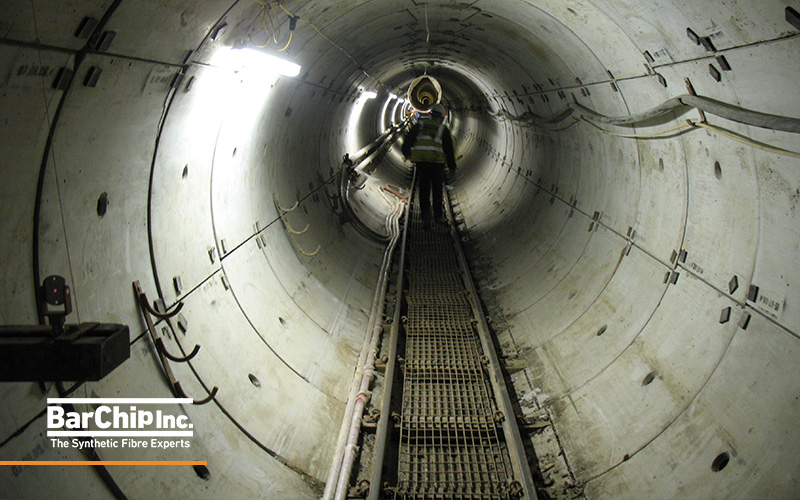
Completed in 2009, the Harefield to Southall Gas Pipeline is the first tunnel in the world to incorporate a precast segmental tunnel lining solely reinforced with macro synthetic fibre concrete reinforcement.
Project Details
The Harefield to Southall Gas Pipeline is a 27 bar, 18.5 km, 1.2 m diameter gas pipeline in Middlesex, UK, commissioned by National Grid in West London.
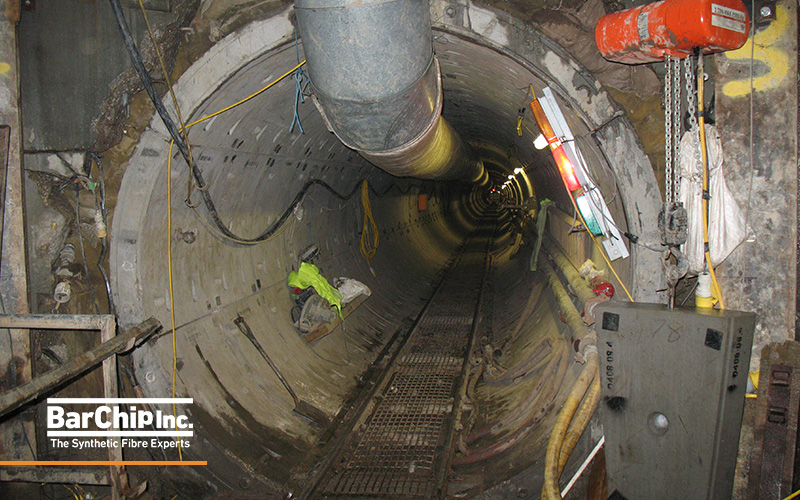
Construction was in a substantially urban environment and required over 2.3 km to be constructed in four 2.5 m diameter segmentally lined TBM driven tunnels, approximately 21 m below ground level. BarChip synthetic fibre was used as the sole reinforcement in 976 m of the precast segmental lining.
Click here to download the Harefield to Southall Case Study from the ITATech Guidance for Precast Fiber Reinforced Concrete Segments- Vol 1: Design.
Design Details
Ground conditions: London clay (a stiff over consolidated clay).
Alignment length: 976 m; Depth approximately 21 m.
Thrust of TBM:
Maximum theoretical thrust: 6800 kN
Operating thrust: 2500 kN
Specified strengths of concrete:
C45/55; flexural strength=5,0 N/mm2;
Residual post-crack=2,4 N/mm2.
Inner and outer diameter: ID 2.59m, OD 2.95m.
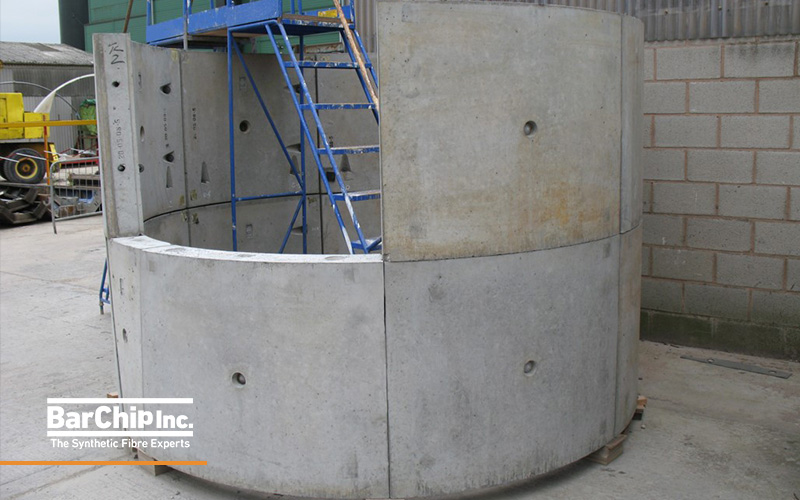
Ring segmentation: 7 segments + 1 key (wedge block).
The original design specification called for steel cage reinforcement consisting of Ø8/250/250 steel mesh reinforcement.
An alternative design with BarChip fibre reinforced concrete was modelling using ATENA FEA software. Using the modified fracture energy method an accurate material model was developed for plain, steel and fibre reinforced sections.
Modelling showed that 7 kg/m3 of BarChip fibre reinforced concrete could exceed the performance of the original steel design. Subsequently, BarChip was specified for the tunnel segments.
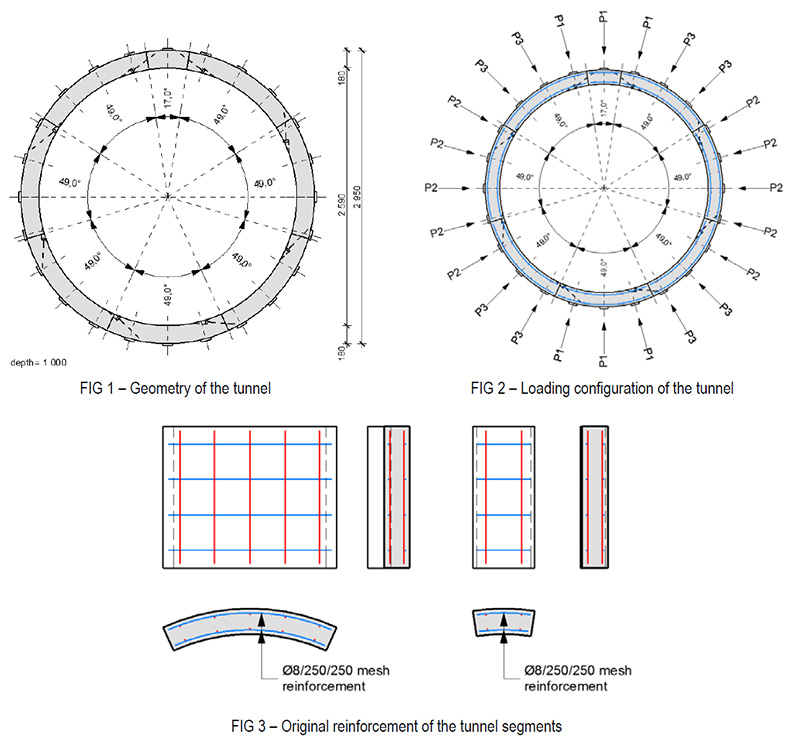
Engineering schematic of the original reinforcement of the tunnel segments. Source: JKP Static.
FEA modelling of principal stress and cracks in the tunnel segments. Source: JKP Static.
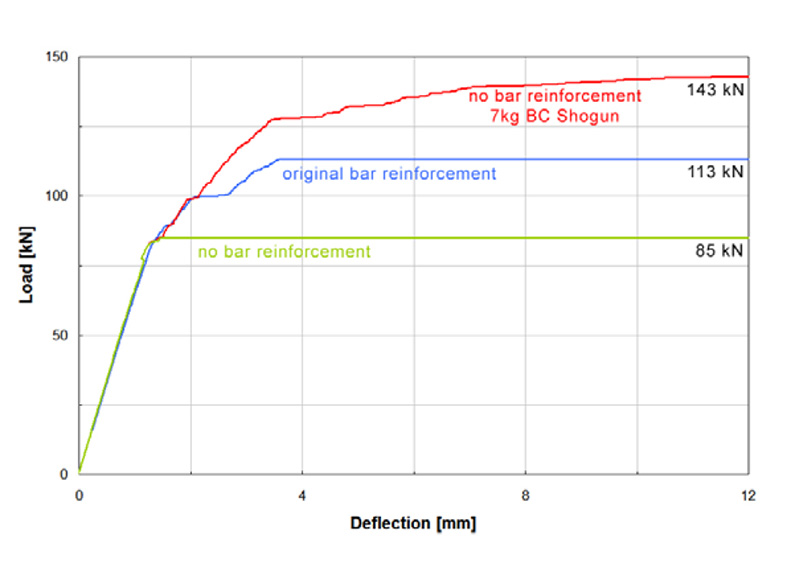
Load deflection diagrams of FEA modelling. Source: JKP Static.
Project Outcomes
The segments were produced at a local precast factory where synthetic fibre was mixed into the concrete then poured into vertical moulds.
The initial segments were pre-assembled at the plant to form a trial ring, ensuring that the correct tolerances were achieved. The segments were then horizontally stacked and trucked to site.
The use of BarChip fibre in these segments proved very effective meeting all the design requirements as well as ensuring that the segments sustained minimal damage from the jacking rams during installation. The segments have since performed to the specified design criteria.
The use of BarChip fibres has lowered the overall carbon footprint of the project, negated any corrosion either of the internal steel gas pipe through cathodic protection and of the segment reinforcement itself.
BarChip provided significant manufacturing efficiencies, including reduced labour costs and faster production that delivered noticeable cost savings to the project.
Barchip’s experienced team can guide you through the design process, providing comparative analysis, structural design and where appropriate complex finite element analysis (FEA). When you design with Barchip, you design with confidence.

JKP Static Project Reference: Utility Tunnel Segmental Lining – BarChip Macro Synthetic Fibre Reinforced