Fibre Reinforced Precast Concrete Pontoons – Port Chernomorets
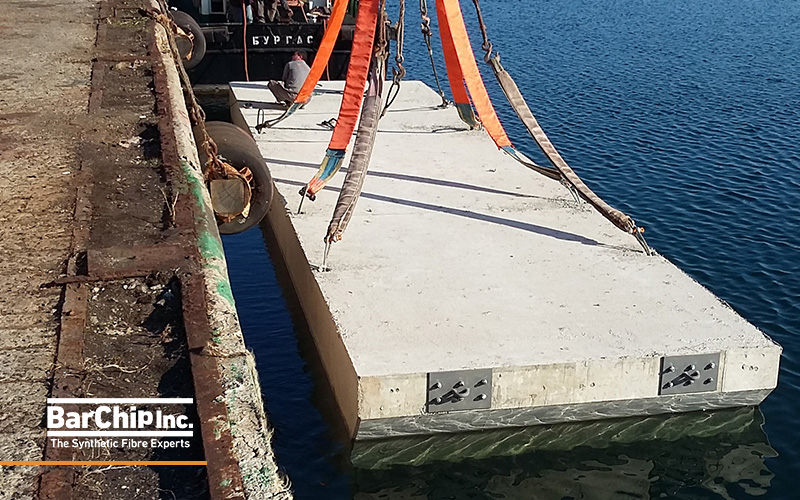
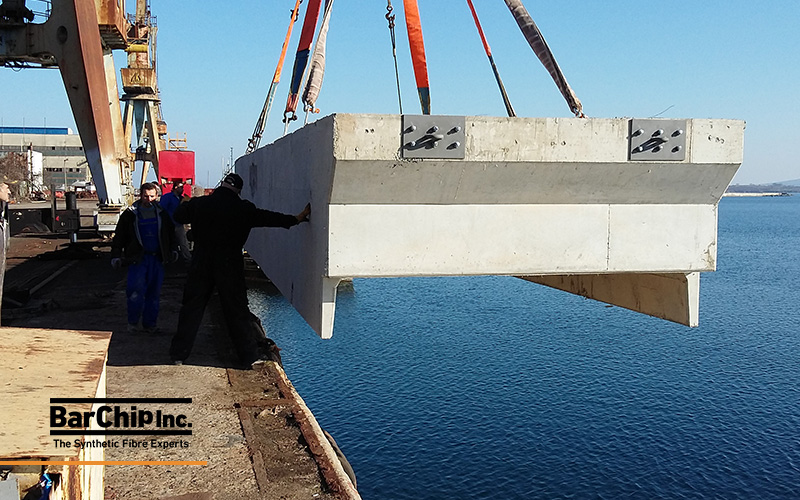
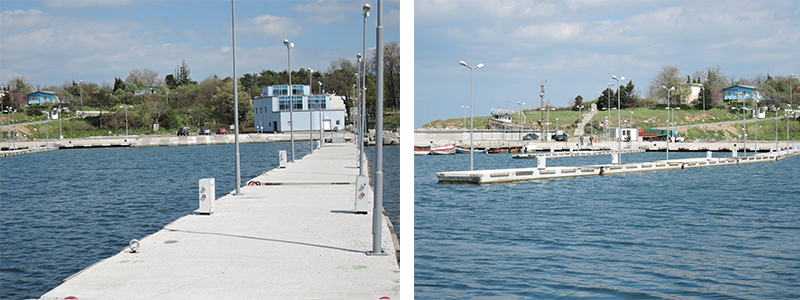
In 2015, Port Chernomorets completed an upgrade incorporating floating precast concrete pontoons reinforced with BarChip macro synthetic fibres. The pontoons were constructed with a concrete shell surrounding a core of polystyrene blocks.
The original design required 718 kg of steel reinforcement. Due to concerns about corrosion in the marine environment, an alternative fibre reinforced concrete design was developed using BarChip 48 macro synthetic fibre.
Design Optimisation
Using finite element analysis (FEA) in ATENA, JKP Static, BarChip and local representative Leaf Group optimised the original reinforcement design. The analysis demonstrated that conventional steel reinforcement could be reduced from 718 kg to 238.1 kg, a reduction of approximately 67%, while maintaining the required structural performance.
The final design incorporated 5 kg/m³ of BarChip 48 macro synthetic fibres together with the reduced steel reinforcement, simplifying reinforcement placement and improving construction efficiency. In addition to reducing conventional reinforcement, the optimised design also lowered the embodied carbon of the reinforcement system by approximately 66%, demonstrating how optimised reinforcement design can deliver both engineering and sustainability benefits.
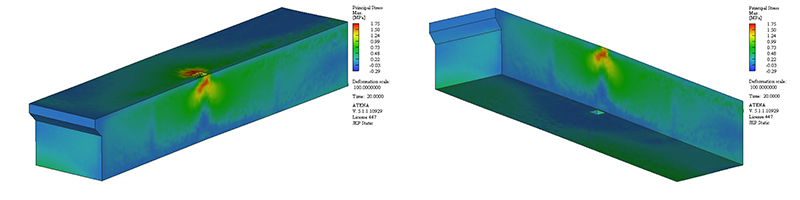
Finite Element Analysis of BarChip Fibre Reinforced Precast Concrete Pontoons
Construction and performance
The fibre reinforced precast concrete pontoons were successfully transported, lifted and installed without damage, demonstrating the structural performance of the optimised design during handling and placement. The success of the project subsequently led to the use of BarChip reinforced pontoons at nearby Sozopol Harbour.
For floating marine structures, long-term durability is equally important. Unlike conventional steel reinforcement, BarChip macro synthetic fibres are non-corrosive and are not susceptible to chloride-induced corrosion. By reducing the quantity of conventional steel reinforcement while maintaining structural performance, the optimised design reduced the risk of corrosion-related deterioration and helped improve long-term durability in the aggressive marine environment.