
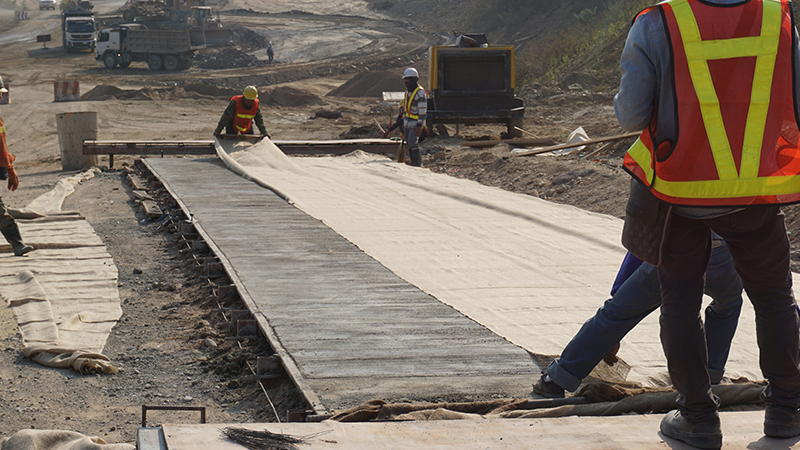
Curing Concrete With Burlap Materials
Curing Fibre Reinforced Concrete: The Final Step in Controlling Strength and Durability
Curing fibre reinforced concrete is the final and most critical step in achieving strength, durability and long-term concrete performance. The curing process maintains moisture and temperature after placement, allowing the cement to fully hydrate. Without proper curing, even the best designed concrete mix can lose strength, develop cracks and underperform in service.
The upper surface of any slab-on-grade concrete takes the greatest wear and determines the life of the structure. Without curing, this surface can become the weakest link, no matter how good the mix or placement.
Why Curing Fibre Reinforced Concrete Matters
Curing ensures the right conditions for hydration, the chemical reaction that gives concrete its strength. If concrete dries too quickly, hydration stops before it’s complete, resulting in lower strength, reduced abrasion resistance and early cracking.
Good curing results in stronger and more durable concrete, with more resistant to chemical attack, freeze-thaw and traffic wear.

Shrinkage Cracks in Hardened Concrete
When to Start Curing Fibre Reinforced Concrete
Timing depends on weather and site conditions. In hot, windy or low humidity environments, moisture can evaporate rapidly, even before finishing, requiring early protection through fog sprays or evaporation reducers. In cooler weather, curing can commence immediately after finishing.
The first three days are the most critical for curing fibre reinforced concrete, as this is when hydration is most active and when plastic shrinkage cracking is most likely to occur. Effective curing during this period greatly improves the long-term strength and surface appearance.
Managing Evaporation and Cracking During Concrete Curing
Surface cracking occurs when the evaporation rate exceeds the concrete’s ability to bleed water. For most conditions, precautions should begin when the evaporation rate exceeds 0.5 kg/m²/h (CCAA guidance) or 1.0 kg/m²/h (ACI recommendation).
To monitor this, measure air temperature, humidity, wind speed and concrete temperature directly on site. Use these readings in the Uno Evaporation Rate Equation or ACI Nomograph to estimate evaporation. Avoid relying solely on automated weather data, site specific conditions are essential for accuracy.
Initial Curing Methods of Fibre Reinforced Concrete
Before final finishing, protect fresh concrete from moisture loss by:
- Fogging: Creating a fine mist above the surface to increase local humidity.
- Evaporation reducers: Forming a thin film that slows moisture loss when evaporation exceeds the bleed rate.

Applying Concrete Curing Compounds and Reducers
Final Curing Methods of Fibre Reinforced Concrete
After finishing, continue curing using one or more of the following methods. Curing should continue for a minimum of three days, ideally seven:
- Water curing: Keep the surface continuously wet using ponding, wet burlap or sand coverings.
- Plastic film: Acts as a moisture barrier; white film minimises heat gain, while dark film retains warmth in cooler conditions.
- Liquid membrane-forming compounds: Sprayed onto the surface to form a moisture seal. Ensure compounds comply with local standards and are compatible with any planned surface finishes.

Curing Concrete With Plastic Film
Results of Proper Concrete Curing
Proper curing of fibre reinforced concrete ensures complete hydration, reduces shrinkage and allows the fibres to perform effectively in distributing tensile stresses across micro-cracks. Good curing delivers measurable performance benefits:
- Maximises strength and durability through full hydration.
- Prevents plastic and drying shrinkage cracking.
- Improves resistance to chemical attack, abrasion and freeze–thaw cycles.
- Enhances fibre performance, ensuring toughness and post crack strength develop as designed.
Whether using BarChip macro synthetic fibres or other reinforcement types, proper curing is fundamental to long term concrete performance.
Download the full Technical Note: Curing Fibre Reinforced Concrete
For detailed curing procedures, evaporation equations and references to ACI and CCAA guidelines, download the full BarChip technical note below.

Technical Note: Curing Fibre Reinforced Concrete