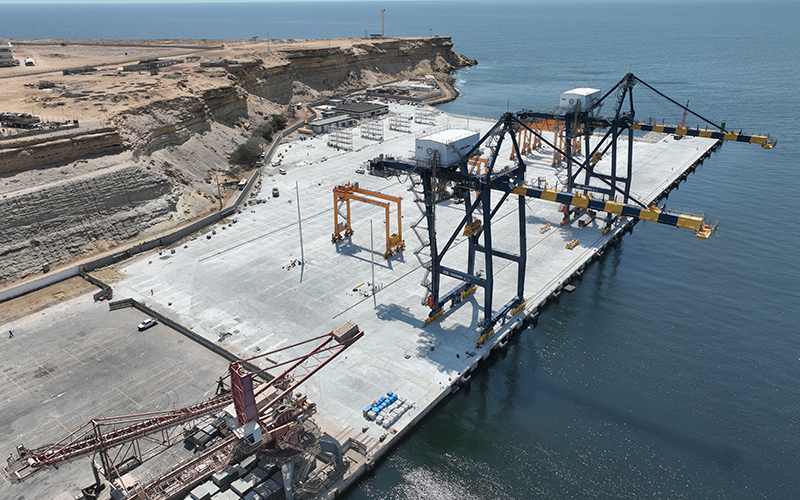
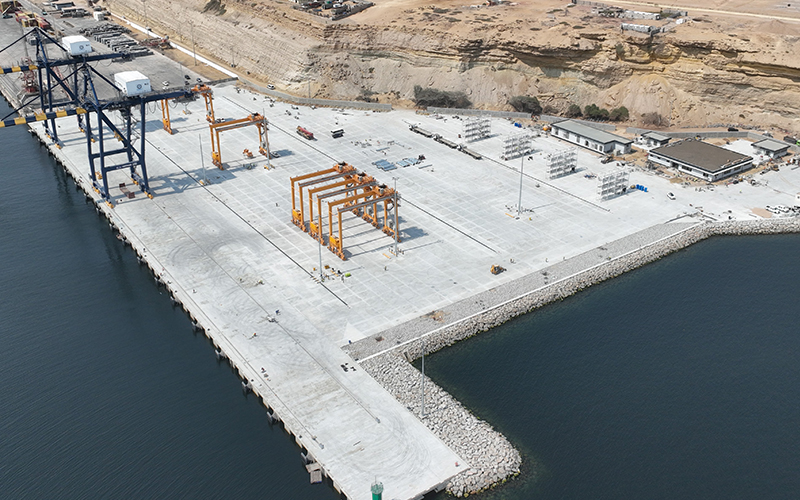
Namibe Port Container Terminal Expansion, Angola
Macro Synthetic Fibre Reinforced Port Pavement
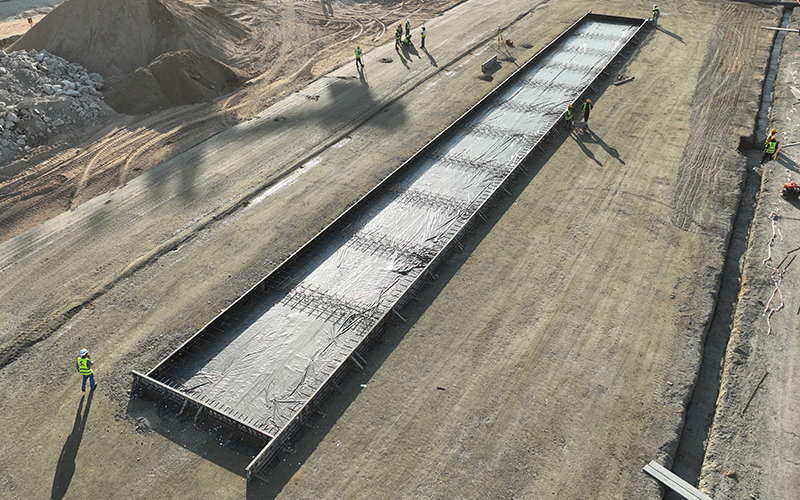
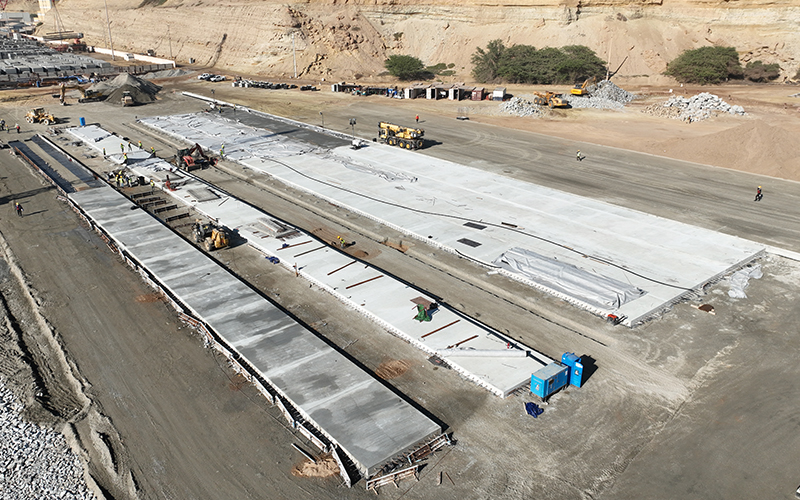
The Namibe Port expansion included the construction of a new container terminal and extensive heavy duty pavement designed for container storage, truck movements and heavy cargo handling equipment. Across approximately 44,500 m² of external pavement, the project required a durable reinforcement solution capable of supporting demanding operational loads and a 120-year design life.
BarChip was engaged to optimise the pavement reinforcement solution, developing the macro synthetic fibre design ultimately adopted for construction. BarChip 48 replaced the conventional top steel reinforcement, with dosages of 3.0 and 4.5 kg/m³ engineered for the loading and ground conditions of each pavement area.
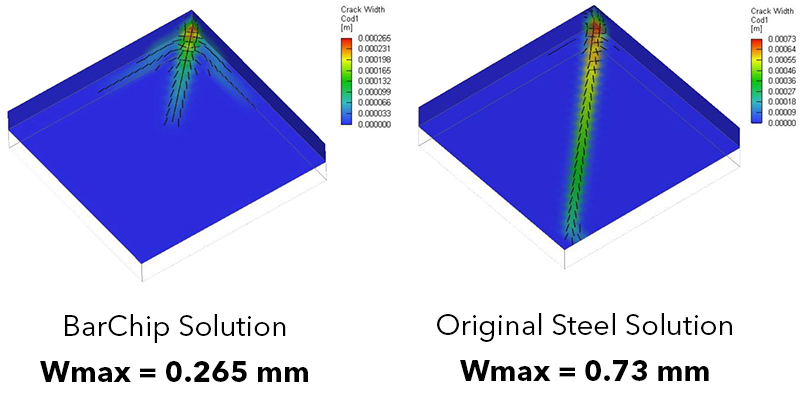
The BarChip solution delivered a 28% reduction in reinforcement embodied carbon and an estimated two-month construction time saving. Nonlinear FEA also demonstrated improved crack control, with calculated maximum crack width reduced by approximately 65%, from 0.73 mm to 0.265 mm.
Quick Facts
Project: Namibe Port Expansion
Client: Ministry of Transport, Republic of Angola
Contractor: Toyota Tsusho / TOA Corporation
Designer: Consulmar
Application: Heavy Duty External Pavement
Total Area: 44,500 m2
Fibre Reinforcement: BarChip 48 @ 3.0 & 4.5 kg/m3
Design: TR34 and Finite Element Analysis (FEA)
Designed for Heavy Port Loads
The pavement was designed with four operational zones, reflecting the different container storage, vehicle and heavy equipment loads across the terminal.
Container storage: 213.4 kN load from containers stacked four levels high
Container trailers: 237.1 kN truck axle load
Reach stackers: 980 kN axle load
Rubber Tyre Gantry (RTG) cranes: 930 kN axle load
Replacing Conventional Steel Reinforcement
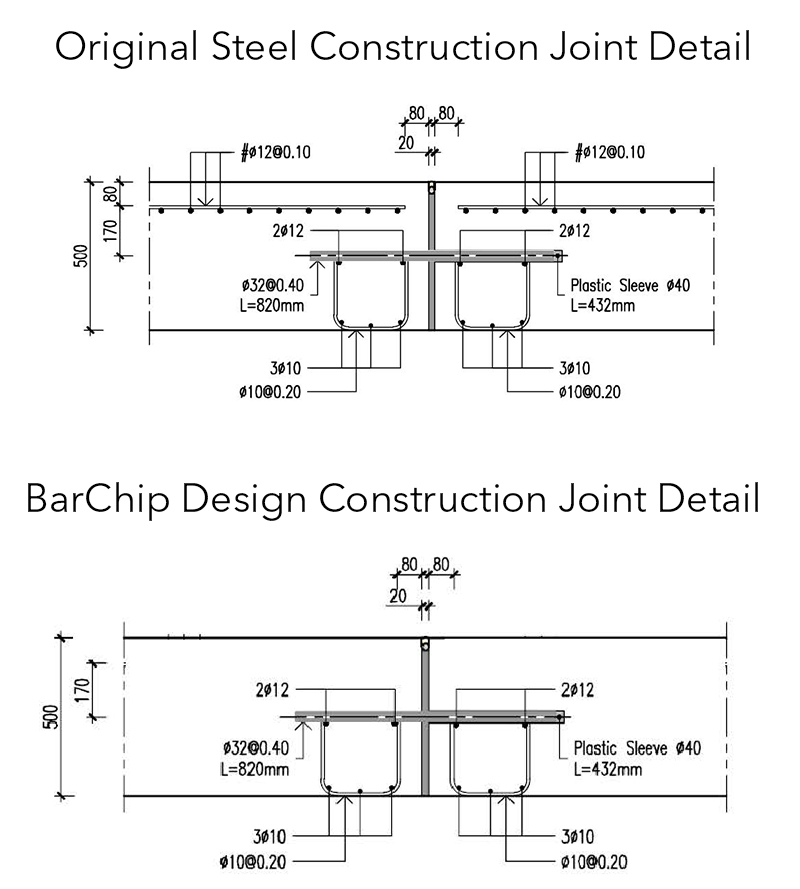
The original pavement design incorporated conventional top steel reinforcement, including Ø12/100/100 mesh in the 500 mm pavement areas, together with steel dowels and tie bars at the joints. The BarChip design replaced the top reinforcement with BarChip 48 while retaining the original pavement thicknesses and joint reinforcement. Fibre dosages were optimised for the loading and ground conditions of each pavement area.
Improved Crack Control
Replacing conventional top steel mesh with BarChip changed the reinforcement system from a single plane of reinforcement to fibres distributed throughout the concrete matrix, engaging across cracks as they develop. Nonlinear finite element analysis (FEA) demonstrated the resulting improvement in crack control under container loading, with maximum crack width (Wmax) reduced from 0.73 mm for the original steel reinforced design to 0.265 mm for the BarChip FRC solution, an improvement of approximately 65%.
Lower Carbon, Faster Construction
Replacing the conventional steel reinforcement with BarChip 48 resulted in a 28% reduction in A1–A3 reinforcement embodied carbon, equivalent to 65,153 kg CO₂e across the project.
Replacing the conventional top steel reinforcement with BarChip 48 simplified construction, eliminating steel installation and delivering an estimated two-month time saving.