
Macro vs. Micro Synthetic Fibres in Concrete – What’s the Difference

Micro and Macro Synthetic Fibre for use in Concrete
Polypropylene based synthetic fibre reinforcement has become a common component in modern concrete technology, offering significant improvements in residual strength, durability and overall performance. There are two recognised classes of synthetic fibres for concrete: micro synthetic fibre and macro synthetic fibre, each serving distinct purposes and providing unique benefits.
What are Synthetic Concrete Fibres?
Synthetic concrete fibres are fibres made from synthetic materials, most commonly polypropylene or polyethylene resins. These fibres are mixed into the concrete to improve properties like shrinkage crack control, residual strength and durability. They are lightweight, corrosion free and resistant to alkalis and salts, making them an ideal choice for use in concrete.
What are Micro Synthetic Fibres for Concrete?
Micro polypropylene fibres are extremely fine, typically ranging from 10 to 20 microns in diameter and 6 mm to 20 mm in length. EN 14889-2:2006 classifies micro fibres as fibrillated or monofilament fibres less than 0.30mm in diameter. Despite some claims to the contrary, micro fibres offer no structural benefit to hardened concrete and should never be used as crack control or structural reinforcement, or in support of a structural design. Micro synthetic fibres are proven to be effective in controlling and minimizing early-age plastic shrinkage cracking. They are also the most effective method of passive fire protection in tunnel linings. Micro fibres cannot be used for reinforcement of concrete and should only be considered an additive.

Fibrillated and Monofilament Micro Fibres for Concrete
Benefits of Micro Fibres in Concrete
Shrinkage Crack Control: Can reduce plastic shrinkage cracks that occur during the early stages of concrete curing. They help to block water flowing through the pores of the fresh concrete, limiting surface drying while concrete is in the plastic state, preventing the formation of shrinkage cracks.
Curling: Helps to reduce the effect of curling while concrete is in the plastic state.
Fire Protection: Theses fibres are proven to be effective in controlling concrete spalling during a fire event. As the fibres melt, they create connected channels that allow steam pressure to escape, which can eliminate explosive spalling.
Applications of Micro Synthetic Fibres in Concrete
- Slabs on Grade: Used in industrial floors, residential slabs and commercial flooring as an additive to control early age shrinkage cracking and reduce curling effects.
- Tunnel Linings: Utilized as passive fire protection in ground support applications for tunneling.
What are Macro Synthetic Fibres for Concrete?
Macro synthetic fibres are larger and coarser than micro fibres, with an equivalent diameter typically ranging from 0.5 to 1.0 mm and lengths up to 65 mm. Macro synthetic fibres increase the post crack residual capacity of concrete and are suitable for use as crack control and structural reinforcement in concrete. Macro synthetic fibres can offer a comparable level of performance in terms of post crack residual strength compared to steel mesh and steel fibre reinforcement.
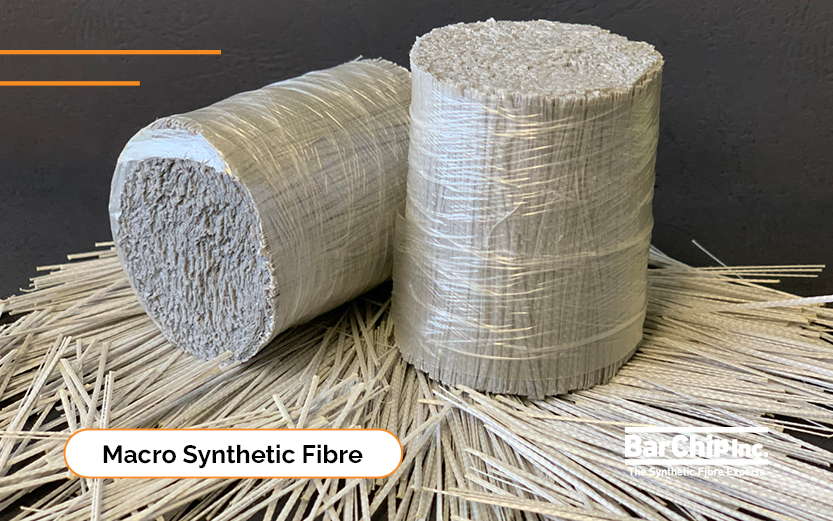
Macro Synthetic Fibre Reinforcement for Concrete
Benefits of Macro Synthetic Fibres in Concrete
- Residual Strength: Macro synthetic fibres enhance the load carrying capacity of concrete, providing additional residual capacity and improving its overall performance.
- Increased Durability: Macro synthetic fibres are corrosion free, significantly improving concrete durability.
- Increased Ductility: macro synthetic fibres change the brittle behavior of concrete to a more ductile material
- Crack Control: Macro synthetic fibres are more effective at controlling crack development compared to steel mesh reinforcement.
- Low Cost: Macro synthetic fibres reduce direct material costs, labour costs and in many cases overall construction time, resulting in cost savings across multiple areas of a construction project.
- Low Carbon: Macro synthetic fibre directly reduces carbon footprint compared to steel mesh and steel fibre reinforcement.
Applications of Macro Synthetic Fibres
- Shotcrete / Sprayed Concrete: Macro synthetic fibre is widely used to reinforce shotcrete ground control in civil works, and in mining and tunnelling excavations.
- Concrete Flooring: Used as a replacement for steel reinforcement in manufacturing plants, distribution centres, warehouses, car parks and external hardstands.
- Precast Concrete: Replaces steel reinforcement in water tanks, septic systems, pipes, pits, cabinets, manholes, tunnel segments and many other precast concrete elements.
- Pavements and Roads: Used in concrete pavements and roads, often in conjunction with thin concrete pavement designs (TCP).
- Concrete Track Slab: Macro synthetic fibre replaces steel reinforcement in concrete track slab, eliminating the time consuming installation of steel bars in confined environments.
Choosing Between Macro Fibre and Micro Fibre in Concrete
Micro and macro fibres may sound similar, but they’re not interchangeable. Each fibre type is engineered for very different roles in concrete, and using one in place of the other can drastically affect both performance and mix behaviour. Unfortunately, after nearly three decades of increasing use, it still happens that the wrong fibre is used for the wrong application. It’s quite simple though:
- Use Micro Synthetic Fibre when you need early-age shrinkage crack control or passive fire protection.
- Use Macro Synthetic Fibre when you need enhanced structural performance, crack control and long term durability, or improvements to other hardened properties of concrete. If you want to replace any steel reinforcement, use ONLY macro synthetic fibres.
Can Micro Synthetic Fibre be Used to Replace Macro Synthetic Fibre?
No. In shotcrete applications such as tunnel linings, micro fibres do not provide the required residual capacity to replace macro fibres. In flooring works micro synthetic fibres are only effective when concrete is in its plastic state. During this time, micro fibres have a positive impact on plastic shrinkage cracking and curling. Once concrete hardens, micro fibres have no impact on concrete properties and offer no increase in residual strength or crack control. This is illustrated in Figure 4 below, where the performance of micro fibre on hardened concrete can be seen in comparison with macro fibre.
Concrete designs that use micro synthetic fibres as “reinforcement” are typically just plain concrete designs using low doses of micro fibre to control curling and plastic shrinkage cracking. These designs usually need to be thicker concrete sections to compensate for the lack of reinforcement, which ultimately makes them more expensive and less sustainable.

Can Macro Synthetic Fibre be Used to Replace Micro Synthetic Fibre?
In almost all scenarios, macro synthetic fibres cannot replace micro fibres. Traditional macro fibre designs — typically single-strand monofilament fibres with equivalent diameters in the range of 0.5 – 1.0 mm (2000 – 7000 decitex), often crimped, straight or embossed and 40 – 60 mm long — are not so effective for plastic shrinkage crack reduction or passive fire protection. These fibres are designed for post-crack performance, not early-age crack prevention.
However, BarChip MQ58 is different. Its multi-strand design bonds several filaments together along the fibre’s length, which separate during mixing. This design provides residual strength, effective plastic shrinkage crack control and even helps reduce curling. Figure 6 below shows test results demonstrating that typical dosage rates of BarChip MQ58 achieve the same effect as micro synthetic fibre for reduction in plastic shrinkage cracking.
So, the short answer is no, macro synthetic fibres cannot replace micro synthetic fibres, unless you’re using BarChip MQ58 for slab on ground applications, which delivers the benefits of both fibre types in one solution.

Conclusion
Polypropylene fibres, whether micro or macro, play an important role in modern concrete construction. By understanding the differences between these two types of fibres and their respective benefits, engineers and builders can make informed decisions to enhance the performance and longevity of their concrete structures. Incorporating the correct type of fibre reinforcement can lead to more durable, resilient, and cost-effective concrete solutions. Choosing the wrong fibre will lead to concrete failure.
Whether you’re working on a small residential project or a large-scale infrastructure development, BarChip macro synthetic fibre concrete reinforcement can significantly improve the quality, durability and cost of your concrete works.

Download: Research on the Effect of Fibre on Plastic Shrinkage Cracking
Download Article: Micro vs Macro Synthetic Fibre in Concrete