

Core Applications of Macro Synthetic Fibre Reinforced Concrete
Macro synthetic fibre reinforced concrete (MSFRC) has become a mainstream reinforcement solution across global markets. Fibres are designed to provide post crack residual strength, toughness and long term durability, and to improve construction efficiency and safety. This article explores core macro synthetic fibre reinforced concrete applications and the measurable performance and commercial benefits it delivers.
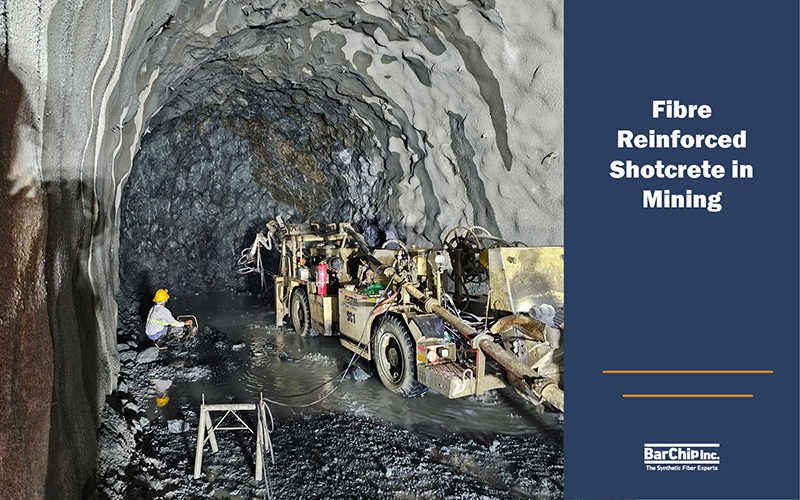
Fibre Reinforced Concrete in Mining
In underground mining, fibre reinforced shotcrete has been widely adopted across global markets as a primary ground support solution. It’s mostly used in hard rock mining, but is also applied in soft rock environments, including underground coal mines, where testing has shown that shotcrete can help limit the release of hazardous gases.
Typical mining applications include shotcrete linings in access tunnels, haulage drives, production drifts, ventilation tunnels, service tunnels and large underground caverns. Fibre reinforced shotcrete is also used to stabilise cutbacks, portal openings and other exposed rock faces.
The inclusion of fibres significantly increases the ductility and toughness of shotcrete, enabling controlled deformation under load. This is a critical performance characteristic in mining environments, where large ground movements and dynamic loading conditions are common.
Typical Mining Applications
- Shotcrete tunnel linings
- Underground cavern linings
- Mine portals and declines
- Slope stabilisation works
- On-site paving and flooring works
Benefits in Mining
- Creates a safer work environment
- Corrosion-free reinforcement (with macro synthetic fibre)
- Lower carbon footprint
- Increased residual strength (post crack capacity)
- Improved ductility
- Faster installation cycles
- Reduced transportation needs
- Lower maintenance burden
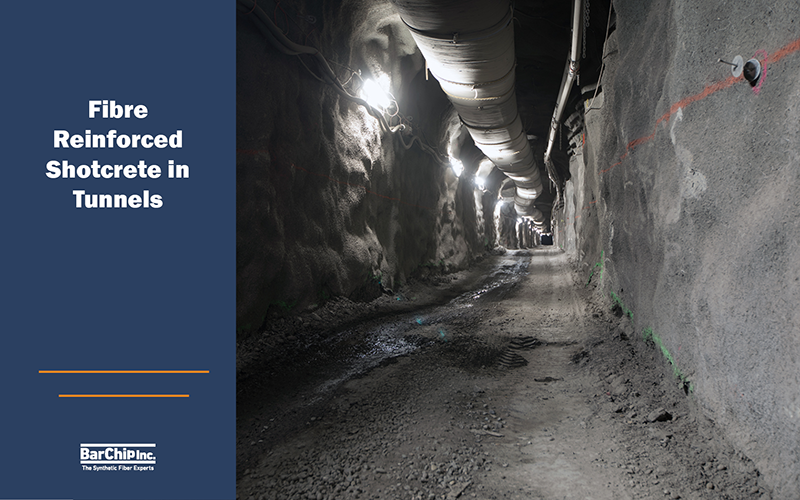
Fibre Reinforced Concrete in Tunnelling
Fibre reinforced concrete is commonplace in global tunnelling infrastructure and is a standard reinforcement solution in many underground projects. Macro synthetic fibre reinforced concrete applications are found across hydroelectric, road, rail and metro tunnels, as well as sewer and water utility tunnels.
Fibres are incorporated into sprayed concrete temporary and primary linings, cast in-situ secondary linings, precast segmental linings, inverts and shafts. They are also used in concrete track slabs within metro tunnels and in general concrete works throughout tunnel projects.
Fibres improve crack control, toughness and durability, and in the case of macro synthetic fibres, eliminate the risk of corrosion. They also simplify construction compared to traditional mesh reinforcement, supporting faster and more efficient construction.
Typical Tunnelling Applications
- Sprayed concrete temporary and primary tunnel linings
- Cast in-situ secondary linings
- Precast segmental tunnel linings
- Tunnel inverts and slabs
- Concrete track slab
- Slope stabilisation works
Benefits in Tunnelling
- Excellent residual strength performance
- Eliminates corrosion risk
- Reduced labour compared to mesh installation
- Shorter construction time
- Reduced carbon footprint
- Enables thinner shotcrete layers (less material consumption)
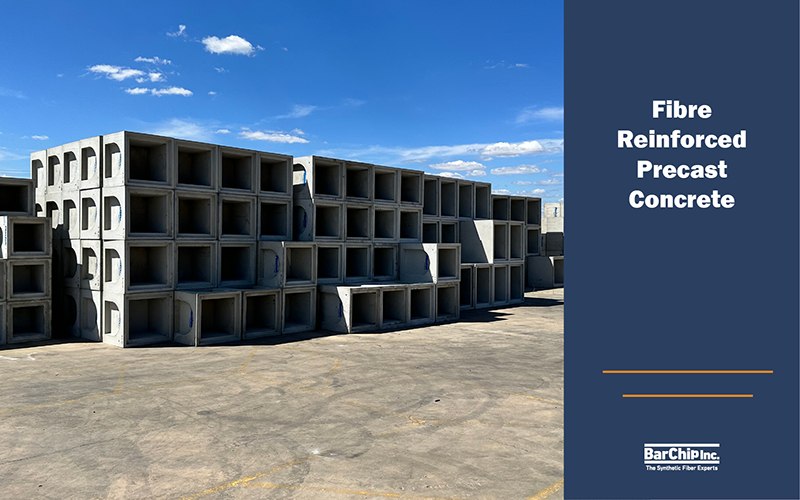
Fibre Reinforced Concrete in Precast
Fibre reinforced concrete is used in precast manufacturing as an alternative to traditional steel mesh and bar reinforcement. Fibre reinforcement is incorporated across numerous precast concrete products, including water and wastewater tanks, box culverts, panels, pits, pipes, cabinets and barriers.
Fibres eliminate steel cages and mesh, removing the time and labour required for cutting, tying and placement of reinforcement. This simplifies preparation, streamlines production processes and improves overall manufacturing efficiency.
Macro synthetic fibre reinforcement also enhances crack control and durability of precast concrete while eliminating corrosion risks and improving long-term performance.
Typical Precast Applications
- Tunnel segments
- Concrete pits and cabinets
- Water and wastewater tanks
- Box culverts
- Barriers
Benefits in Precast
- Improved crack control
- Potential for thinner elements (reduced concrete usage)
- Corrosion-free reinforcement (with synthetic fibre)
- Faster mould preparation
- Safer handling (no steel rollout)
- Reduced labour cost in manufacturing
- Embodied carbon reduction versus steel
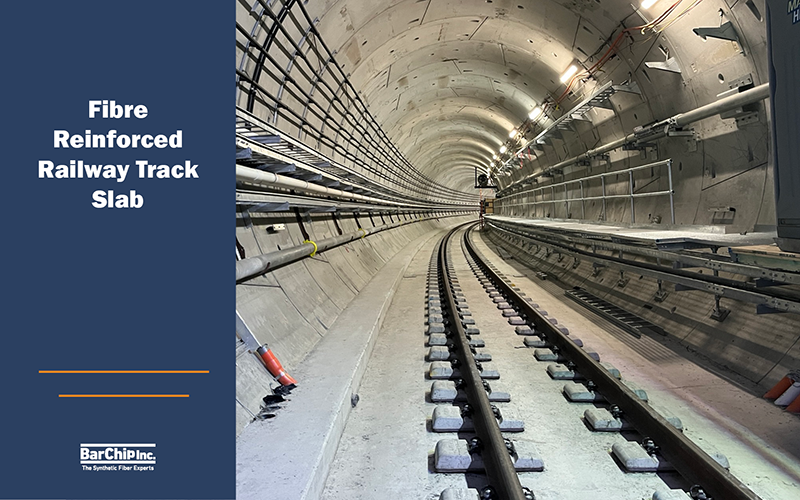
Fibre Reinforced Concrete in Railway Track Slab
Synthetic fibre reinforced concrete is increasingly used in rail infrastructure, particularly in concrete track slab systems for metro, light rail and high-speed rail networks. Fibre reinforcement is applied in both precast and cast in-situ track slabs, as well as in associated base slabs and inverts.
In track slab construction, fibres can eliminate traditional mesh reinforcement, simplify installation processes and reduce complexity around rail fixings and embedded components. This enables faster, more efficient construction and makes installation easier for work crews.
Typical Track Slab Applications
- In-situ rail slabs
- Light rail and tram systems
- Embedded rail systems
- Metro track slabs
- Base slabs and inverts
- Depot slabs
Benefits in Track Slab
- Post crack load capacity
- Simplified construction processes
- Reduced labour costs
- Lower carbon footprint
- Faster construction
- Long-term durability without corrosion
- Reduced material transport to site
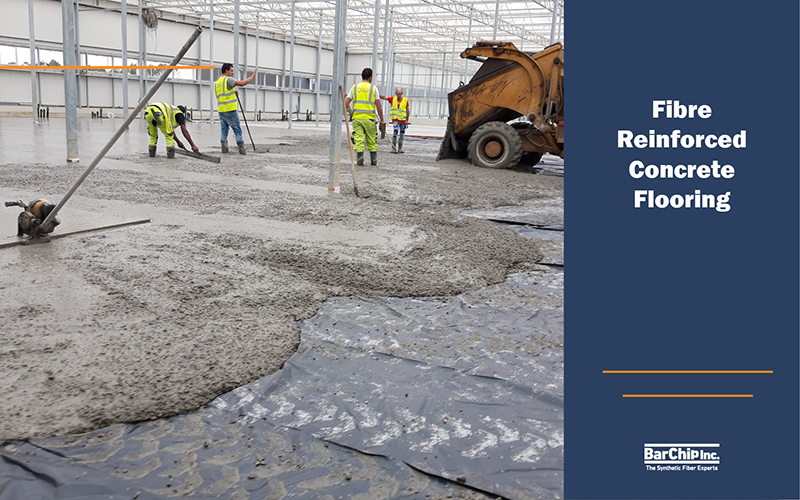
Fibre Reinforced Concrete in Industrial Flooring
Industrial flooring is a major application of synthetic fibre reinforced concrete, particularly in warehouses, distribution centres and manufacturing facilities. It is used in slab-on-ground construction, including both jointed and jointless floor systems.
Fibres can eliminate traditional steel mesh, reduce on-site labour and simplify placement. In both jointed and jointless floor systems, macro synthetic fibres enhance crack control, toughness and load transfer performance, supporting durable slab behaviour.
BarChip MQ58 delivers a unique three-for-one benefit in flooring applications: structural post crack residual strength, effective control of early age shrinkage cracking and a fibre free surface finish. This integrated performance simplifies reinforcement design while supporting durable, high quality concrete construction.
Typical Flooring Applications
- Warehouses and distribution centres
- Manufacturing facilities
- Cold storage slabs
- Retail and logistics hubs
- Heavy duty hardstands / external pavements
Benefits in Flooring
- Structural mesh replacement
- Enhanced durability
- Faster slab construction
- Reduced labour cost
- Improved crack control
- Lower embodied carbon
- Safer installation
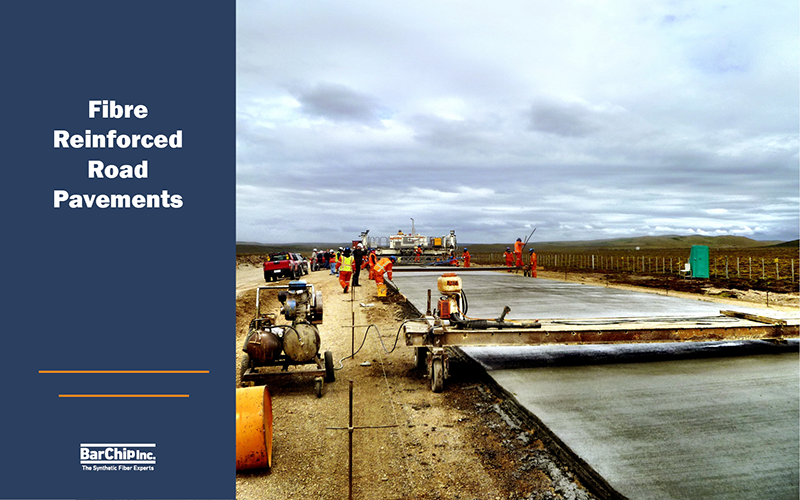
Fibre Reinforced Concrete in Road Pavement
Synthetic fibre reinforced concrete is widely used in road pavement construction, including highways, industrial access roads, port pavements and freight corridors. BarChip has been extensively applied in concrete road projects, predominantly in conjunction with thin concrete pavement (TCP) systems, where structural performance and crack control are critical.
Fibre reinforced concrete is well suited to modern slipform paving equipment used in road construction. In continuous slipform paving machines, and macro synthetic fibres disperse uniformly within the mix without interfering with extrusion or consolidation. Because fibres are batched directly into the concrete and require no mesh placement ahead of the paver, they support uninterrupted paving operations and help maintain production rates.
In pavement applications, macro synthetic fibres eliminate the need for traditional mesh reinforcement, removing steel deliveries, storage and on-site fixing operations. This simplifies logistics, reduces labour requirements and supports faster construction programs.
Typical Road Pavement Applications
- Highway pavements
- Bus lanes and freight corridors
- Port pavements
- Industrial access roads
- Residential development roads
Benefits in Road Pavements
- Faster construction
- Reduced labour cost
- Improved crack control
- No steel mesh installation
- No corrosion risk (with macro synthetic fibre)
- Potential reduction in slab thickness
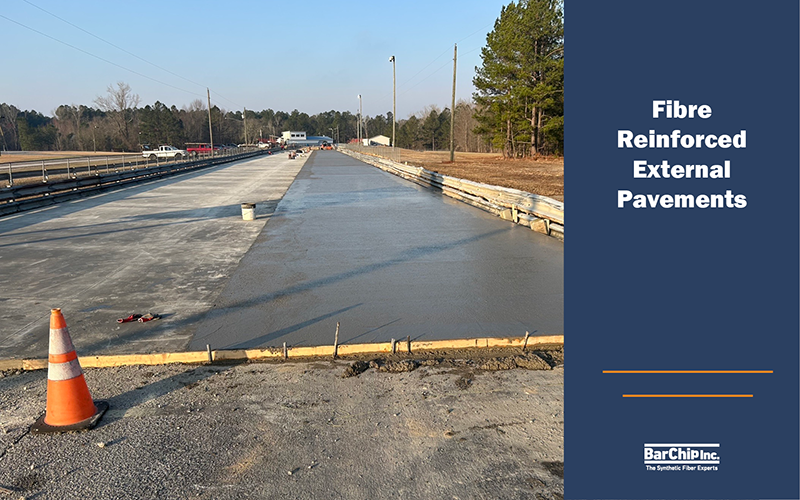
Fibre Reinforced Concrete in External Pavements
External pavements are a common application for synthetic fibre reinforced concrete, including hardstands, car parks, loading areas, shared paths and access roads. These slabs are often exposed to variable ground conditions, weather cycles and intermittent traffic loading and benefit from reliable crack control and long term durability provided by fibre reinforcement.
Macro synthetic fibres eliminate light steel mesh in these applications, simplifying construction and reducing on-site handling while removing corrosion risk in exposed environments.
Fibres are compatible with a variety of placement and finishing methods used in external pavements, including conventional and slipform paving equipment, supporting efficient construction without hindering machine operation. This supports faster placement, improved safety and consistent slab performance.
Typical General Pavement Applications
- Car parks and hardstands
- Driveways
- Footpaths and shared paths
- Agricultural slabs
- Service yards
Benefits in General Pavements
- Better crack control
- Improved durability
- Simplified construction process
- Eliminates corrosion of reinforcement
- Faster construction
- Lower embodied carbon
Why Macro Synthetic Fibre Reinforced Concrete Is Growing Globally
Across all industries, macro synthetic fibre reinforced concrete applications deliver consistent structural performance while offering clear construction and durability advantages. Its ability to provide reliable crack control, eliminate corrosion risk and simplify installation processes makes it a versatile reinforcement solution across a wide range of infrastructure and building applications.
Key drivers for synthetic fibre adoption include:
- Structural post crack residual strength
- Corrosion free reinforcement
- Faster construction
- Reduced labour costs
- Improved worker safety
- Reduced logistics complexity
- Embodied carbon reduction compared to steel reinforcement
- Long term lifecycle performance
- Reduced maintenance
Macro synthetic fibre reinforced concrete supports the construction industry in prioritising durability, safety and carbon reduction while delivering more efficient and resilient concrete reinforcement outcomes.