
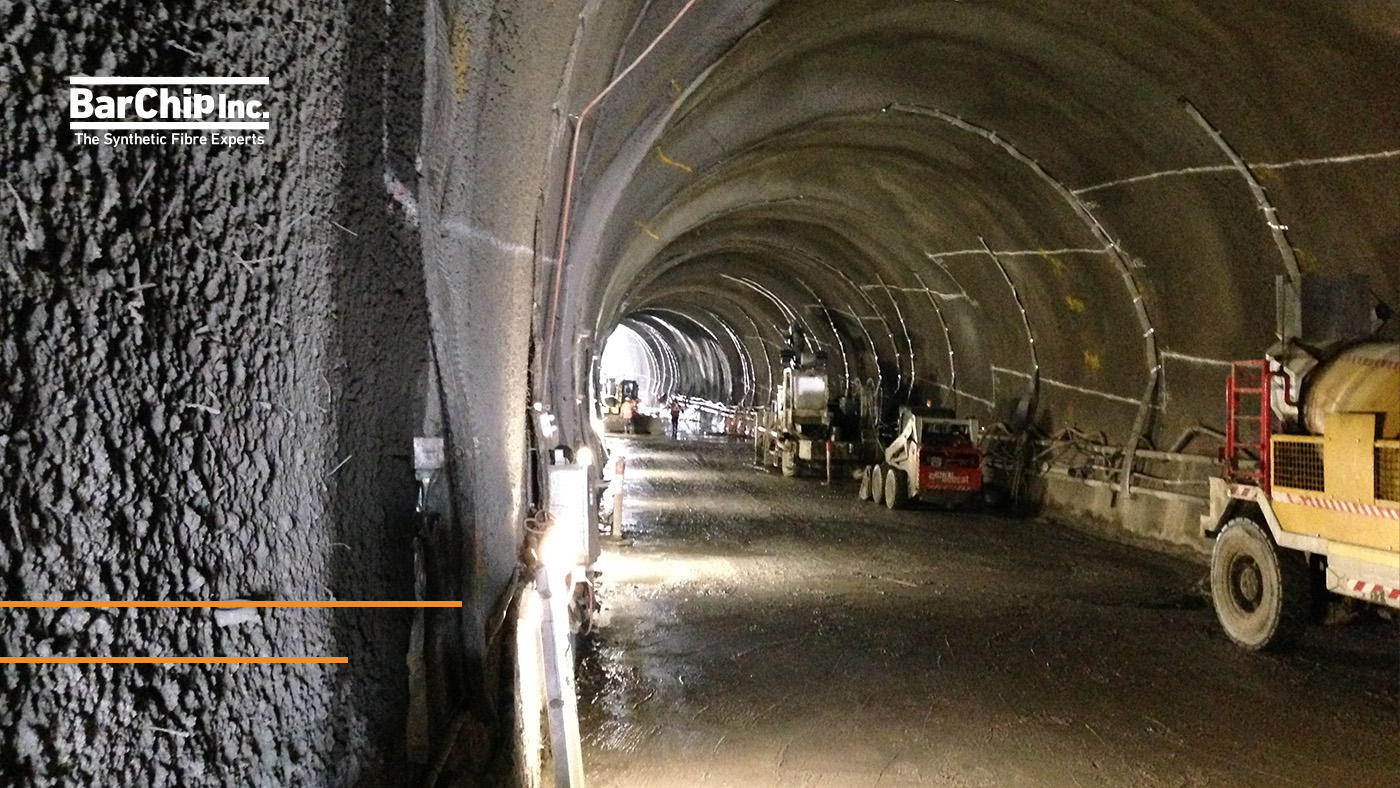
North Strathfield Rail Underpass – Fibre Reinforced Permanent Sprayed Concrete Tunnel Lining
The North Strathfield Rail Underpass used BarChip macro synthetic fibre in a 250 mm single-pass permanent sprayed concrete tunnel lining, eliminating the need for steel sets and lattice girders.
Downloading the paper, “The North Strathfield Rail Underpass- Driven Tunnel Design and Construction” – M Gonzalez, M Kitson, D Mares, B Muir, T Nye, and T Schroeter.
The North Strathfield Rail Underpass in Sydney, Australia, is a 148 m long rail tunnel constructed beneath operational passenger and freight railway lines. The permanent ground support consists of a 250 mm thick BarChip macro synthetic fibre reinforced single-pass sprayed concrete lining, designed to provide structural performance without steel sets or lattice girders.
Excavated by roadheader with a maximum ground cover of just 3 m, the tunnel required a ground support system capable of supporting construction loads while forming part of the permanent tunnel lining. BarChip macro synthetic fibre provides post-crack residual strength and stress redistribution within the sprayed concrete, while also helping control shrinkage cracking and providing corrosion-free reinforcement for the tunnel’s 100-year design life.

The project was delivered by the NSRU Alliance (TfNSW, John Holland and Bouygues). The lead designers were the DJV of SKM and PB with Mott Macdonald the designer of the driven tunnel discussed here.
The tunnel was excavated through track ballast, fill and shale rock, with the shale weathered near the surface. Steel canopy tubes drilled ahead of the tunnel face provided initial support, followed by the 250 mm single-pass wet mix sprayed concrete lining. No steel sets or lattice girders were required. The arched tunnel profile was designed so that the fibre reinforced sprayed concrete remained predominantly in compression under dead and live loads, with BarChip macro synthetic fibre providing the required post-crack performance within the permanent lining.
Barchip’s macro synthetic fibers performed four key functions within the lining;
- To minimise shrinkage cracking within the shotcrete lining.
- To provide residual strength and redistribute stresses within the lining.
- Are environmentally friendly and will not deteriorate over the 100-year life of the tunnel.
- The final shotcrete layer is 100mm in thickness using micro synthetic fibers to reduce spalling in the event of a fire. Although macro fibers were not specifically used for fire and are not as effective as micro fibers for this purpose, the underlying macro synthetic fibers in the structural shotcrete layer will also help to reduce spalling in the event of a fire.
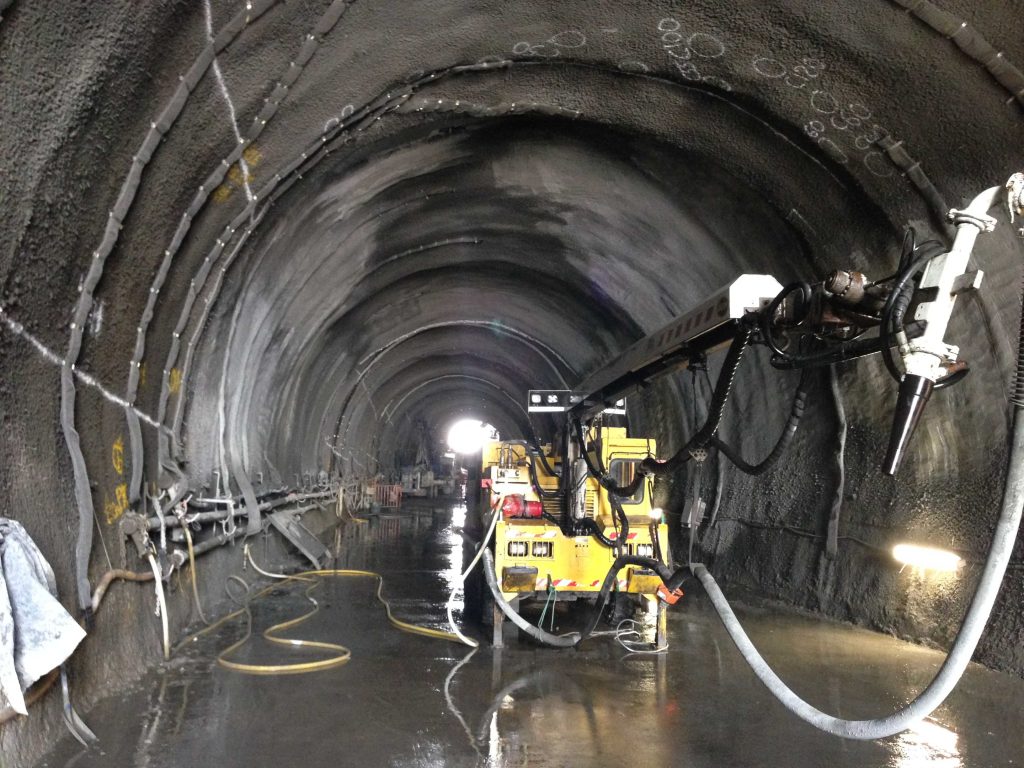
The tunnel excavation was completed with no distribution to the railway operations above. Some additional facts are;
- The construction method used 12m long grouted steel canopy tubes and approximately 35no., 12m fiberglass dowels across the face followed by incremental excavation, which were carried out in 1.3m to 1.5m lengths with shotcrete built up in multiple layers immediately behind the tunnel face. A new array of canopy tubes and pattern of face dowels were installed every 9m length of tunnel with a minimum of 3m overlap.
- Shotcrete 3m back from the face was approximately 250mm thick and at the face 150mm thick before the next excavation cycle. Shotcrete at the face had to have a minimum strength of 6MPa before commencing the next excavation cycle.
- Canopy tubes and fiberglass dowel installations were staggered at 4.5m intervals to allow the following shotcrete lining additional time to gain strength and to ensure there was always support at the face (with overlaps of the canopy tubes and dowels).
- The original concept (by others) was a cut and cover tunnel design but the ability to close active commuter rail lines for construction times little more than 4 weekends per year would have resulted in a construction period extending over many years compared to the driven tunnel which was excavated in 8 months.
- Train operators have no control over the freight train cargo content and as such the tunnel was designed to withstand a 4-hour hydrocarbon fire with significant loss of the shotcrete lining thickness.
- There is no mechanical plant in the tunnel itself to maintain. There is a low point tunnel sump in the dive structure at the northern portal of the tunnel.
Without applying some innovation, firstly by adopting a driven tunnel rather than the cut and cover option, this tunnel would have been more difficult to construct (the tunnel alignment was also moved 60m north from the original alignment to site in better geology). Once the driven tunnel had been selected the opportunity to apply innovations to the driven tunnel was then initiated.